
Not So Secret Strategies To Lower Your E-Mod
Eight practical strategies to lower your workers' compensation E-Mod, reduce claims, and build a safer workplace — from safety culture to proactive claims management.
Introduction
For many business owners, workers' compensation insurance is one of the largest insurance expenses they face. A key factor that influences your premium is your Experience Modification Rate, commonly known as your E-Mod. Understanding how your E-Mod works and knowing how to manage it can lead to significant savings while creating a safer workplace.
What Is an E-Mod?
An Experience Modification Rate is a numerical factor used by insurance carriers to adjust your workers' compensation premium based on your company's claims history. It compares your business's loss experience to other businesses of similar size and industry.
- E-Mod of 1.00 = Average risk for your industry
- E-Mod below 1.00 = Better-than-average claims performance
- E-Mod above 1.00 = Worse-than-average claims performance
For example, if your workers' compensation premium is $50,000 and your E-Mod is 1.25, your premium could increase to $62,500. If your E-Mod is 0.80, your premium could decrease to $40,000.
Why Your E-Mod Matters
A lower E-Mod doesn't just reduce insurance costs. It can also:
- Improve competitiveness when bidding on contracts
- Help qualify for preferred insurance programs
- Enhance your company's reputation for safety
- Increase profitability by reducing operating expenses
Many general contractors and government projects require subcontractors to maintain an E-Mod below a specific threshold, often 1.00 or lower.
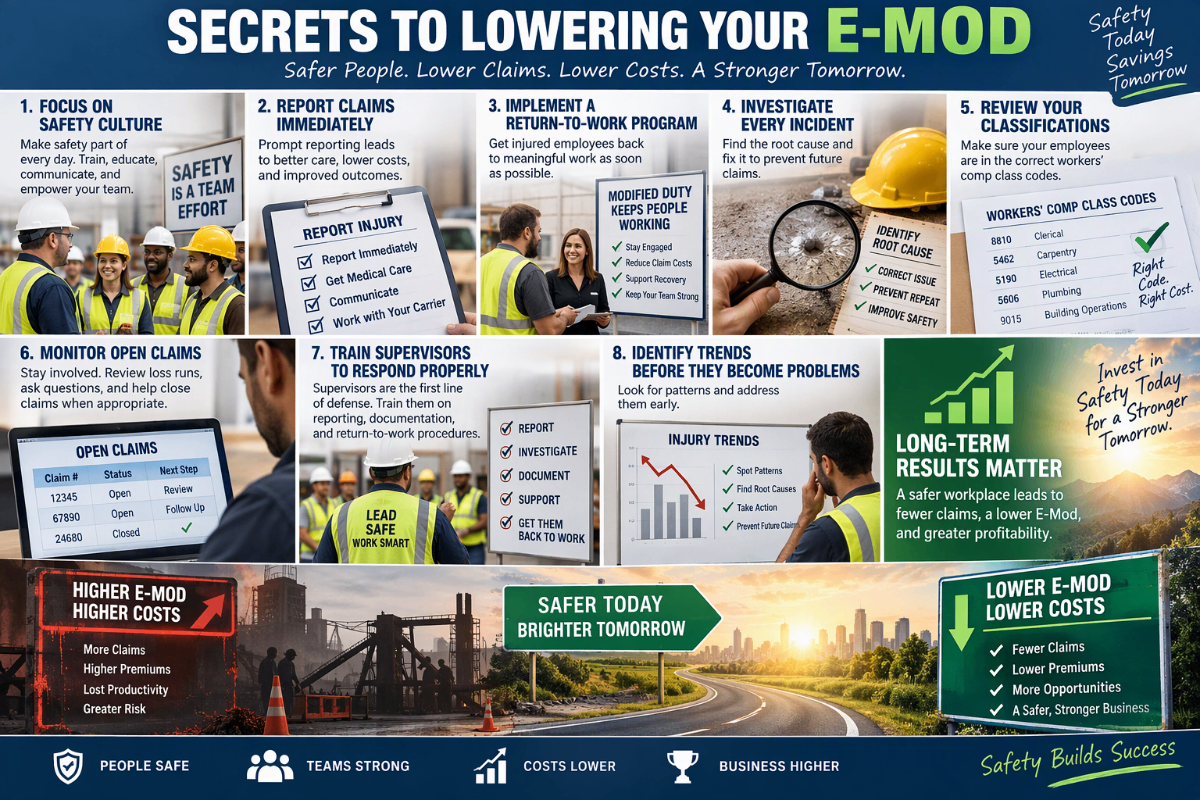
Secret #1: Focus on Safety Culture
The most effective way to lower your E-Mod is to prevent injuries from occurring in the first place. Develop a workplace culture where safety is part of every employee's daily routine. Conduct regular safety meetings, provide proper training, enforce safety policies, and encourage employees to report hazards immediately. When employees understand that safety is a priority, claim frequency typically decreases.
Secret #2: Report Claims Immediately
Delaying the reporting of workplace injuries can increase claim costs significantly. When an injury occurs:
- Report the claim promptly.
- Ensure the employee receives appropriate medical treatment.
- Maintain communication with the injured worker.
- Work closely with your insurance carrier and adjuster.
Early intervention often leads to better outcomes and lower overall claim costs.
Secret #3: Implement a Return-to-Work Program
One of the biggest drivers of workers' compensation costs is lost-time claims. A structured return-to-work program allows injured employees to return to modified duty while they recover. This can dramatically reduce claim costs by minimizing wage replacement benefits and maintaining employee engagement. Examples of modified duties may include:
- Administrative tasks
- Safety inspections
- Inventory management
- Training assistance
Secret #4: Investigate Every Incident
Even minor incidents should be investigated. By identifying the root cause of accidents, businesses can implement corrective actions to prevent future claims. A simple slip-and-fall accident may reveal a larger issue such as inadequate housekeeping procedures or poor lighting. Every claim offers an opportunity to improve workplace safety.
Secret #5: Review Your Workers' Compensation Classifications
Incorrect classification codes can result in higher premiums than necessary. Regularly review your payroll classifications with your insurance agent to ensure employees are assigned to the correct workers' compensation class codes. Accurate classifications help ensure your premium reflects your actual risk.
Secret #6: Monitor Open Claims
Many employers assume that once a claim is filed, there is nothing more they can do. In reality, staying involved can make a major difference. Review loss runs regularly and discuss large or aging claims with your carrier. Sometimes claims remain open longer than necessary, increasing reserves and negatively affecting your E-Mod. Ask questions such as: Is the employee back at work? Are reserves still appropriate? Can the claim be closed?
Secret #7: Train Supervisors to Respond Properly
Supervisors are often the first point of contact when an injury occurs. Training supervisors on injury reporting procedures, accident investigation, documentation, and return-to-work practices can substantially reduce claim severity and improve outcomes. A well-trained supervisor can help prevent a small claim from becoming a costly one.
Secret #8: Identify Trends Before They Become Problems
Review injury patterns regularly. Look for:
- Repetitive injuries
- Specific departments with higher claim frequency
- Common accident causes
- Seasonal trends
Addressing trends early can stop future claims and improve your long-term loss experience.
Long-Term Results Matter
Reducing your E-Mod is not about finding quick fixes. It's about building a safer workplace, responding effectively to injuries, and actively managing claims. Most E-Mod calculations are based on multiple years of claims history, which means consistency is critical. Businesses that focus on safety, employee training, and proactive claims management often see lower workers' compensation premiums and stronger financial performance over time.
Final Thoughts
Your E-Mod can be one of the most powerful factors affecting your workers' compensation costs. By investing in workplace safety, maintaining an active return-to-work program, managing claims aggressively, and reviewing your insurance program regularly, you can position your business for long-term savings and success.
At Lucas Insures, we help businesses understand their workers' compensation program, identify cost-saving opportunities, and develop strategies to improve their E-Mod.
A lower E-Mod means lower premiums, safer employees, and a stronger bottom line.
Disclaimer
The information provided is for general educational purposes only and does not constitute legal, financial, or insurance advice. Coverage details, limits, and eligibility vary by policy and carrier. No guarantee of accuracy or applicability is made, and this information may not apply to any particular individual, business, or claim. Some images we share are created using AI to help visualize real-world insurance situations. They're designed to educate and engage, not to represent actual claims or clients and they may not apply to you or your business. Always review your specific policy documents and consult your licensed insurance agent for guidance on your situation.